Go to Techniques Back to
Main Page
Page Updated 12-2-11
The Page for the Non-BPD's
|
Page entirely devoted to Non's.
=> Are
you a Non-BPD?
(Click link for assessment if you are a person
dealing with a Borderline, and if you have the traits of a
"Non-BPD"). |
|
|
As
this site has been under continuous revision and expansion, it has
become evident to me that I needed to insert a page for the Non-BPD's.
Many people who have gone to this site are not Borderlines.
For every person diagnosed with BPD, there are 5-15 people on the
average who interact closely with that person. It is these
people (the Non-BPD's) who need to know where they can turn
for support. This page is for you.
YOU are a very important contributor: 1) for maintaining your
own sanity 2) helping to diffuse a Borderline "Moment".
Also, you need to know why they are so
resistant to help
from others.
|
|
Topics on this Page:
How to
Help the Borderline
12-2-11
There is DBT
for the Family too **
Books
Family Healing
Non-BPD Legal Help
Support Groups
Things to Do for Yourself
Healthy
Relationships
Articles
- many
Techniques
Resources
Choices
What You Can Do for Your Borderline |
|
DBT for the Family
DBT for the Family
DBT for the Family
DBT for the Family
DBT for the Family
DBT for the Family
Top |
Family DBT
5-25-11
by
Simone Hoermann, Ph.D.
Dialectical Behavior Therapy (DBT) has been applied not only for
adults with personality disorders, but has more recently also been
modified for the treatment of adolescents, couples, or people
dealing with eating disorders or substance use issues. DBT has also
been used to help family members of people with personality
disorders and other mental illnesses. Dr. Elizabeth Wade, the
clinical psychologist I mentioned in last week’s blog, facilitates a
DBT group for family members and concerned significant others of
patients who may be people who are suffering from a personality
disorder, or bipolar disorders, depression, anxiety, substance use,
and eating disorders. “The DBT family group is not confined to only
family members of those with personality disorders, but is open to
families and significant others of clients with a variety of
different issues, “ says Dr. Wade.
Family DBT is set up similar to a regular DBT skills training group
and covers interpersonal effectiveness skills, emotions regulation
skills, and distress tolerance skills. This means that the family
members learn the same skills as their loved one who is attending
DBT groups.
The basis of all these skills is mindfulness, the idea that it is
important to raise one’s awareness of one’s own thoughts, feelings,
and behaviors and how they play out with their family member who is
in treatment. Mindfulness practice can be helpful for dealing with
the concerned family member’s own emotions, since anxiety, anger, or
regret can build up in families and impact people’s ability to
participate in a satisfying life.
The group meets once a week for an hour and fifteen minutes. It is
an ongoing group, which means that new members can join at any time.
A lot of family members like to go through multiple rounds of
learning the skills. It takes about 6 months to complete a full
round of skills, though family members are welcome to stay longer.
Group participants practice their skills in the group and are
assigned a small amount of homework, which they bring back to the
group for fine-tuning and trouble-shooting, much like a workshop.
Participants in the DBT family group reinforce each other in using
effective behaviors, and the group can include as many members of
one family as possible, since they can all affect the family system.
The family member’s participation is often valued by the person in
treatment as a sign that the family cares, a sign that they are
interested and working towards supporting their recovery.
Over the course of the group sessions, family members share their
experiences and support each other, giving suggestions and offering
up resources. It can be helpful for family members to see how other
people are dealing with similar issues. Often, there is a lot of
shame in the family, so that frequently is a liberating experience
to get a sense that one is not the only family dealing with these
problems.
The family members of the patient don’t necessarily have to be in
treatment themselves, but it certainly can be helpful if they are.
What is important for the participation in the group is that the
patient is in treatment, and that the family member is willing to
listen to others and to participate in the group by speaking about
their personal experiences as they relate to the skills. In the
course of the group, participants learn some skills for effective
communication and some crisis management skills, and they also are
encouraged to learn how to take care of their own emotional needs.
Often, the group provides a sense of relief that while another
family member is going through difficulties, there is something that
a concerned other can do, and that it is acceptable, even important,
to take care of one’s own needs and concerns in order to be able to
support a loved one.
|
|
Books
|
by
Melody Beattie
by Ozzie
Tinman
"One Way
Ticket to Kansas" **see below
by Paul Mason & Randi Kreger
"Stop Walking On Eggshells: Taking Your Life Back When Someone You
Care About Has Borderline Personality Disorder"
(read about it)
by Randi Kreger (about
Kreger)
"The Essential Family Guide to BPD (New
Tools and Techniques to Stop Walking on Eggshells"
by Henry Cloud:
"Boundaries: When to Say Yes, How to Say No to Take Control of Your
Life" (read
about it)
by Robert Friedel M.D.
"An Essential Guide to Understanding and Living With BPD"
(read
about it)
by Mary Lynne Heldmann
"When Words Hurt: How to Keep Criticism from Undermining Your
Self-Esteem"
(read about
it)
by Patricia Evans:
"The Verbally Abusive Relationship"
(read about it)
by John Bradshaw:
"Healing the Shame That Binds You" (read about it)
** Read
essay on a Borderline's "take" on
this book
|
Family
Healing
Top |
The
Five Stages of Discovery for Family Members
Paul Mason. MS,
CPC, and Randi Kreger, Excerpt from "Stop Walking on Eggshells"
Click link
(1-8-10) |
Non-BPD Legal Help
 |
by
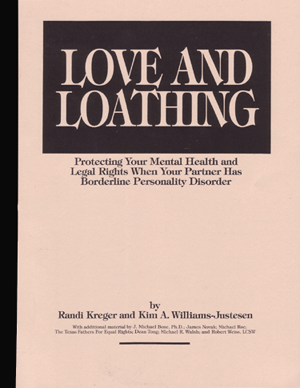
Randi Kreger & Kim Williams-Justesen
"Love &
Loathing"
This book is for people in
romantic relationships in which one of the partners has BPD.
Discussion of how to survive the romantic emotional roller coaster
ride, how it affects children and how to decide what to do; legal
experts explain how to deal with the legal issues often involved in
divorce, such as child custody battles, false accusations, and
restraining orders. Should you need to legally leave the BPD you
are married to, this booklet is about protecting your mental health
and your Legal Rights. |
|
Support
Groups
Top
|
Stories from Non-BPD's (14 stories - 1 of them could be your story)
Largest
support group
in the world for those coping with a
Borderline
Welcome
to Oz another large support group
A large
support group of "Ozzies"
(Non-BPD's)
(10-26-09)
If you
STAY with
your Borderline (Non-BPD support group)
(10-26-09)
Many different
support
groups
|
|
Knowing
Who You Are
and
What You
Need to Do
for Yourself
|
Recovery
& Affirming Tools for Non-BPD's
-
A Non’s Bill of Rights
-
Take care of Yourself
(10-24-09)
-
Boundaries: What are They and Why
Do I Need Them
-
Modalities
-
Setting Appropriate and Effective
Boundaries
-
Determining if you have Healthy
Boundaries
-
Stress and Anger Management
-
Boundaries and Privacy
-
Grief and Loss
-
Introduction to the Healing
Affirmation
-
A Non’s Healing Affirmation
- "I am a Non"
-
Triggers
-
The Price of Keeping the Silence
(7-8-10)
-
According to Harriet P.
Lefley, Ph.D, a technique called the "three R's"--Recognizing,
Resisting, and
Reconstructing—-may help you
support the BP (a person either diagnosed with BPD or is
undiagnosed but has BPD traits) in your life while paving the
way for you to set your own limits. Her suggestions are based on
her experiences with lower-functioning offspring.
She explains the technique in a chapter of a new
clinically-based book about BPD, "Understanding and Treating
Borderline Personality Disorder" (American Psychiatric Press,
2005).
The three R's stand for:
*RECOGNIZE that the
BP (person with BPD or BPD traits) lives in a world of distorted
mirrors. Parents and their BP children have vastly different
perceptions of reality. You may, she says, feel harassed,
accused or threatened. But your borderline family member feels
that he or she is the victim of your perceived inability to
recognize and honor their pressing needs.
*RESIST getting drawn
into their swirling emotionality triggered by your refusal to
give into inappropriate demands. When the BP acts out
outrageously, she says, it's natural to want to fight back. But
it's the wrong move. If you can keep your cool—maintain your
boundaries and refuse to be provoked into anger, criticism, and
rejection—you can help the BP calm themselves down. This creates
a win-win situation.
*RECONSTRUCT the
relationship, in part by learning how to deal with verbal abuse,
forming your own support system (see below), and appreciating
that your rights must also be respected.
|
|
|
Healthy Relationships |
LisaKiftTherapy.com:
Help for Healthy Relationships
(12-3-09)
Read On
The
Non-Mantra (8-22-09) |
|
Articles
|
by Randi Kreger "Isolation:
for Partners of Someone with BPD"
by Kathi Stringer
"The
Non Dilemma" (about Non-BPD's)
by Kathi Stringer
"Disclosing BPD to an Undiagnosed Spouse" |
|
|
Techniques |
P.U.V.A.S. |
|
Resources
Top |
|
|
Choices for Non-BPD's
Top |
|
|
|
Non-BPD's:
What You Can Do for Your
BPD
/ BPD Teen
|
|
|
|
Top |
|
|
|
What
to Do When Your Child Refuses Borderline Personality Disorder
Treatment
by
Clearview Treatment on Dec 01, 2011 in Family & Friends, Treatment &
Therapy
Whether your child is just into their 20s or well into adulthood,
you may find you’re having difficulty getting them to enter
Borderline Personality Disorder (BPD) treatment. Your child may be
in denial about their diagnosis or simply unwilling to get BPD
treatment. But you know it will help. So what do you do?
Here
are a few ways to swing their decision the other way if they are not
relenting.
Educate Your Child about BPD
You may come off as pushy, but continue to make efforts to educate
your child about Borderline Personality Disorder and its treatment.
It is imperative for them to understand the nature of the
psychiatric disorder that they are diagnosed with. Knowledge of the
problem and the fact that it is surmountable may spur your child’s
desire to get better.
Validate Their Feelings
Since an individual with Borderline Personality Disorder suffers
from symptoms such as unpredictable mood swings, compulsive
behaviors, and unstable relationships, they are quite likely to feel
misunderstood. This can lead to people with BPD feeling lonely,
unheard, and unaccepted. One of the first steps toward getting your
child to say yes to BPD treatment is to try to be empathetic toward
their feelings and actions. Tell them you understand why they behave
certain ways at times. If your child feels you understand them, they
are more likely to listen to your advice on getting BPD treatment.
Explain the Benefits of BPD Treatment
Perhaps your child does not trust treatment or understand how it
could actually help them. Take them to a therapist or BPD treatment
center that can better explain how treatment will work to improve
their BPD symptoms. If possible, make arrangements for them to meet
people in BPD support groups who can explain how treatment helped
them recover from BPD. Such steps could go a long way in changing
your child’s perspective on not getting BPD treatment.
Show
Tough Love
When all else fails, it might be the time to practice some
disciplinary measures. For example, if your daughter has refused BPD
treatment for a number of months, deny her financial help. This may
seem like manipulation or sound contradictory to providing
validation, but sometimes it’s just essential to show some tough
love. The key here is to be balanced. Be understanding, but warn
them that they will not be allowed every comfort until they decide
to enter BPD treatment.
Promise Some Perks
Perhaps your child has been longing to take piano lessons? You could
entice them into entering Borderline Personality Disorder treatment
by promising to buy them a piano once they complete treatment. Or
maybe they want their own apartment? Tell them you’ll help with rent
if they opt for BPD treatment and sincerely adhere to it through the
entire course.
As a
parent, it’s very important for you to not give up, even if your
child continues to be disinterested in Borderline Personality
Disorder treatment. BPD treatment will improve their BPD symptoms
and give them the tools needed to live a more functional life.
Top
Healing the Shame that
Binds You
by John Bradshaw
Shame
is at the root of BPD and many other mental concerns. Chapters
include The Faces of Shame, the Sources of Toxic Shame, Liberating
Your Lost Inner Child, On Loving Yourself, Integrating Your Disowned
Parts, Confronting and Changing Your Inner Voices, and Dealing with
Toxic Shame in Relationships. A classic.
"I
have been told that the work of George Vallient, MD is quite
illuminating about BPD and much more positive than the 'lay press'
presents. I haven't yet read his works but from what I have heard I
still recommend perusing his works."
Top
Boundaries: When to Say Yes, How to Say No
to Take Control of Your Life
by Henry Cloud
Persons that benefit from this book
include pushovers who have allowed people to pick on them their
whole lives and parents who have a hard time disciplining children.
Schoolteachers, pastors, and students benefit from this book as
well. On a deeper level, Boundaries has actually helped those
struggling from the affect of childhood abuse. For instance, young
women who grew up not being able to say no to a man who asks for sex
can now say so. Better yet, she can so so without worrying if he
is ever going to talk to her again. Additionally, friends can set
limits with other overly-needy friends by using the content of some
of the chapters in Boundaries, which comes with a corresponding
workbook by the same title. This book has been used in
counseling sessions, as well as in group workshops. Moreover, people
have purchased a copy and have read it in the privacy of their own
home. Anyone can benefit from this book.
Topics Covered in Boundaries: When to
Say Yes, When to Say No to Take Control of Your Life, include the
following:
1. How to
effectively communicate without making excuses or feeling guilty
about it. 2. How to enforce your boundaries when they are being
challenged. How to end or limit unhealthy
relationships. 3. When to say yes or no. 4. How to discipline
a child who is not behaving. Prevent from
being
overworked. 5. How to
discipline a child who is not behaving properly. 6. How to
prevent from being further overworked. Boundaries series is
considered thought of as one of the most
practical boundary-setting guides of the 20th and 21st
century.
Top
A Warm Bath for the Brain
by Linda Graham
Understanding
Oxytocin's role in
therapeutic change
Q: The couples I see often are in such a
state of emotional arousal that they can't calm down enough to do
the work of therapy. What can I do to reduce their agitation and
help them become more emotionally open, to me and to each other?
A: I know exactly what you mean. Take a recent session of mine.
Lisa started yelling at her husband, Andy: "You never talk to me
anymore! I'm sick and tired of you never saying anything! You're a
brick wall!" He sat frozen on the couch, staring at his hands.
When clients are emotionally worked up, caught in
fight-flight-freeze mode, all their hard-earned skills in empathic
listening and responsible (and responsive) speaking go out the
window. Nothing therapeutic is going to happen until they feel calm
enough and safe enough to reengage with each other.
So I
quickly asked them to do what I knew would calm Lisa down and
re-engage Andy in less than a minute.
"Stop! Breathe.
B-r-e-a-t-h-e. Place your hand on your heart. Breathe any calm you
can muster right down into your heart center."
They did,
because they've done this before with me, and they knew it works.
"Let yourself relax into that calm. Now remember any moment you can
of safety, trust, love with each other, any moment at all. Get the
sense of that memory in your body. Feel the love and the trust in
your body. Settle into it. Relax and breathe."
In less than a
minute, Lisa felt calm enough and Andy felt safe enough to reengage
in the work they knew they need to do to rebuild the trust,
connection, and intimacy that'll save their marriage.
What
happened inside their brains that allowed them to recalibrate so
quickly? How can they make it happen again whenever they feel
overwhelmed, to give their relationships a chance to heal?
What happened was that
Oxytocin flooded through their
brains.
Oxytocin is a naturally occurring
hormone, which stimulates feelings of bonding and trust and reduces
fear and anxiety by reversing the stress response. Just one of many
neurochemicals that neuroscientists now know are potent catalysts of
psycho-physiological change,
Oxytocin is extremely relevant
for us therapists: it is the neurochemical basis of the sense of
safety and trust that allows clients to become open to therapeutic
change.
Produced in the hypothalamus, deep in the midbrain,
Oxytocin is released naturally
into the bloodstream through warmth, touch, and movement. Orgasm and
breastfeeding generate
Oxytocin. It also floods our
brains and bodies when we're in close proximity to someone by whom
we feel deeply loved and cherished. Even evoking memories of people
close and dear to us will spark its release.
Do clients need
to know how the release of
Oxytocin calms and soothes them
to benefit from its effects? Maybe not. But I've learned that
clients love the sense of mastery and agency that comes from knowing
not only how the
Oxytocin response works, but how
they can stimulate it within themselves.
Andy reported in the
next session that just two days before, Lisa was in a high state of
agitation when she was running late getting their recalcitrant
4-year-old son to preschool. He was afraid that saying anything
would make matters worse, so he stood in the doorway where Lisa
could see him with his hand on his heart. Lisa caught herself,
stopped, met his gaze, and put her hand on her heart, too. He took
one step toward her; she took three steps toward him. They melted
into a 20-second, full-body, "tend and befriend"
Oxytocin-releasing hug, and then
calmly got their son to school, on time, without further upset.
Lack of warmth and touch in clients' earliest attachment
relationships can derail the full maturation of
Oxytocin receptors in the brain.
A deficiency in this "molecule of motherly love" makes it much
harder for them to "feel" the love and trust available to them in
other relationships, later in life.
Our "re-parenting" of
clients—allowing them to experience us as reliably secure attachment
figures or helping couples experience each other as secure
attachment figures—contributes to rebuilding those receptors in the
brain, even after years of depression and loneliness. Many times, I
explicitly evoked Andy's previous experience of me, and of Lisa, to
stimulate feelings of the safety and bonding that were available to
him, saying things like:
"I'm feeling touched as I hear you
talk about your fears of speaking up with Lisa. I'm so moved that
you would share that with me, with us."
"That was quite a lot
of sadness you let yourself feel just now. What's it like to feel so
much sadness and share those feelings with me? With us?"
"What do you see in Lisa's eyes as you share your sadness with her?
What do you see in her eyes as she feels what you feel?"
Scientists are discovering that helping clients shift their
neurochemical responses from the fight-or-flight response of
cortisol to the calm-and-connect response of
Oxytocin
primes the brain to alter
the ways neural networks process emotions, thoughts, memories, and
feelings. According to Sue Carter of the Chicago Psychiatric
Institute, a single exposure to
Oxytocin can make a lifelong
change in the brain. Therapy offers enough sustained exposure to
Oxytocin that clients can rewire
large segments of implicit relationship "rules."
In other
words, by strengthening our clients' conscious ability to stimulate
the release of this hormone, we can begin to rewire the deep
encoding of habitual, often unconscious, patterns of response to
relational distress. The more we do this with them, the more
permanent the changes become.
Linda
Graham, M.F.T., is in full-time private practice in San Francisco
and Corte Madera, California, specializing in relationship
counseling for individuals and couples. She offers consultation and
trainings nationwide on the integration of relational psychology,
mindfulness, and neuroscience. She publishes a monthly e-newsletter
on Healing and Awakening into Aliveness and Wholeness, archived on
www.lindagraham-mft.com, and is writing a book to be entitled
Growing Up and Waking Up: the Emergence of the Whole Self. Contact:
lindagraham2@earthlink.net This e-mail address is being
protected from spambots. You need JavaScript enabled to view it .
Tell us what you think about this article by e-mail at
letters@psychnetworker.org This e-mail address is being
protected from spambots. You need JavaScript enabled to view it , or
at www.psychotherapynetworker.org. Log in and you'll find the
comment section on every page of the online Magazine section.
Top
Borderline Personality Disorder
Demystified: An Essential Guide to Understanding and Living
With BPD
by Robert Friedel M.D.
Demystified is primarily directed to diagnosed borderline patients
seeking information and support. There is a chapter for family
members in which he cites material from Stop Walking on Eggshells
(1998, New Harbinger). He writes, “Stop Walking on Eggshells seems
to strike a responsive chord in people [whose BP loved one] lacks
insight into their problems and refuses to seek professional help.”
The inclusion of material for family members of undiagnosed BPD's not
in treatment is encouraging.
The
book’s advice for Non-BPs includes a) learn more about the disorder,
b) be supportive, c) join an appropriate support group, and d) try
to convince the BP to go into treatment, but accept that you can’t
make them do so. Friedel’s own sister had BPD, so his understanding
comes from first-hand experience. He also writes, “Remember that
it’s the responsibility of the person with BPD to take charge of his
or her behavior.”
Top
When
Words Hurt: How to Keep Criticism from Undermining Your
Self-Esteem
by Mary Lynne
Heldmann
Understand how and why criticism undermines
your self esteem Take control of your responses to criticism Listen
to and think objectively about criticism Deal with childish
responses to criticism Balance your feelings with rational thinking
Build self-esteem in the midst of a verbal attack Give criticism
tactfully yourself. "A self-liberation guide for victims of verbal
abuse...a wealth of ideas for protecting oneself from attack without
counterattacking."
Top
The Verbally Abusive Relationship
by Patricia Evans
The book that introduced the
term "verbally abusive relationship" to the world!
“A
groundbreaking book...” Newsweek
“This is the
first time I have read a book about myself. It is so clearly
defined—I believe this book has saved my life.” —J.M., Danville, New
Hampshire
“I have
highlighted practically the whole book...I recommended it to my
youngest daughter just an hour ago. Wish I’d been able to read it 36
years ago!” —M.M., Sedelia, Missouri
“No one has ever
explained this tragedy as you have.” —A.W., Denver Colorado
“Thank you for
writing (this book) for me and the thousands of women everywhere who
suffer in abusive relationship.” —B.L., Clayton, California
Top
Stop Walking On Eggshells:
Taking Your Life Back When Someone You Care About Has Borderline
Personality Disorder
by Paul Mason & Randi Kreger
Do you feel that anything you do
or say will be twisted against you? Are you being accused of things
you never did or said? Do you try to avoid horrible, confusing
arguments by concealing your thoughts and feelings? Are you at the
end of your rope?
Top
Why Are Borderlines So Resistant to
Help?
by A.J. Mahari
(8-5-09)
A large portion of the
resistance of many borderlines stems firstly and
foremostly from all of the pain and damage they have
suffered. Pain that they have
abandoned in attempts to try to cope with the
distress of their
emotional dysregulation. Borderlines
experience what are ruptures of varying degrees in
connectedness in relation to others as broken trust.
Broken trust is experienced with the duality of the
borderline's past superimposed upon the unfolding
here and now that they are not often very
emotionally aware of. Unresolved issues of
abandonment and feelings of broken trust and
betrayal (usually more rooted in the past) along with
the absence of a known self lead the borderline to
defend against the truth as others see it and express
it.
Borderlines often feel abandoned
and betrayed by someone who tries to tell them the
truth. Remember, if you are a family member, loved one,
or relationship partner of someone with BPD, the truth,
as you know it, is a truth that those with BPD do not
have any interpersonal skills to cope with any potential
distress they may feel in response to it. Therefore,
they protect against it and dismiss it as "your
problem".
The person with BPD has lost his
or her authentic self. He or she lives from and through
a
false self and this false self does not know
what it needs or wants. The false self -- the
borderline lost self in a frantic search for a way
to meet needs and avoid pain creates layers and layers
of defense mechanisms - which are experienced as
"feelings". The defense mechanisms of the borderline
false self are experienced by the person with BPD as
foreign and as coming inward for outside of "self" - as
coming from others when the distress is really coming
from within a part of them they are dissociated from and
afraid of. Within the lost-ness of an unstable identity
-- a lack of identity, often, a borderline is not aware
that they need help. To them, life is just as it has
always been and the hurts, the problems, the torments
are everyone else's fault and or responsibility. Many
borderlines do not have any understanding or
self-awareness from which to "know" that they do indeed
need help. And when in that kind of emotional pain and
upheaval often nothing feels like help. For the
borderline nothing offered as help is good enough until
the borderline begins to (in therapy) engage the process
that is the journey From
False Self to Authentic Self.
Top
|
|
|
P.U.V.A.S. from the book "Love &
Loathing" by Kreger/Williams-Justeson
This technique can be used to respond
to a Borderline who is projecting, accusing, being overly blaming or
critical, or who is making unreasonable demands. The
Borderline will often get angrier because he is not feeling heard.
So he becomes more insistent and louder.
P= Pay
attention U=Understand fully V=Validate the BP's
emotions => these are for the BPD's needs
A=Assert with "My Reality statement" S=Shift
responsibility for the BP's feelings and actions back to the BP=>
A and S address the Non-BPD's needs
Pay Attention when it is your turn to listen, really listen.
Don't think about what you are going to say. Do NOT become
defensive and tune out the BPD, even if they are accusing you of
things you never did or said. This accomplishes helping you
validate the BP's feelings, and it will assist you in detecting
emotions that may lie beneath the surface.
Understand
fully: Make sure you gently challenge any vague
generalizations you don't understand. Don't defend yourself.
Validate the BP's emotions The BP's feelings
may not make sense in your world, but they certainly make sense in
their world. Very important: do not judge, deny them,
trivialize them, or discuss whether you think they are "justified".
Do not ask condescending; the BP may get enraged if you do not sound
like you are taking their concerns seriously.
Assert
yourself with "My Reality Statements" Some
reality statements will reflect your opinions, and that's okay. This
is where some negotiating could come in to resolve the upset.
Shift responsibility for the BP's feelings/actions back to
the BP Let them know that you support them, but only
they can make themselves better. This is hard. Leaning
new behaviors is difficult. Don't expect miracles.
Don't take the BP's reactions or your discomfort as failure.
Top |
Healthy
Relationships
You can
be honest about how you feel without armor on. You expect to be
and feel loved and respected. You can listen/sympathize with your
partner without wanting to fix them. You realize that both
partners need to continually compromise to meet both's needs
Balance is achieved. You and they have your own interests and own
friends outside of relationship. Mistakes are acknowledged, and
things go on. When you need emotional support, you get it from
your partner. Both of you are RESPONSIBLE and GIVING in the
relationship. Either alternate decision-making, or make decisions
together, or both. Discuss difficult issues without falling
apart. Set aside time each day for nurturing yourself. You
love your partner, but you can survive without them too. You can
express anger in a non-threatening way. Resolve issues in a
constructive way.
Top |
|
The Non-BPD Mantra
(8-22-09)
Memorize and Repeat as Necessary: I am a Non. I
value MY well being , my emotional health, enough to make choices
that allow me to move towards health , wellness and better
relationships... if that includes the person with the disorder in my
life... good... if not... it’s worth the price ... I am worth the
price.
I am a Non... it is NOT my
fault that the person in my life with the disorder is sick... I did
not CAUSE the disorder , I cannot CONTROL it, nor can I CURE it...
It IS my responsibility to care for myself , to work on my health,
and keep myself and children safe.
Copyright (c) 1996-2003 Turtle Island Center
Family Services [1996] Incorporated |
|
Being in a relationship or married
to a mate who has Borderline Personality Disorder (BPD) will be very
trying for all involved. The periods of emotional roller coasters
that will be experienced throughout your relationship can only make
you stronger or break you.
Dealing with the emotional ups and downs of a mate with BPD is
tiring, and is often termed as a sort of Jekyll and Hyde type
behavior. One minute the two of you equally share your adorations
for the other in which your mate is totally into you. Suddenly,
without warning or provocation you become like prey fighting off an
angry animal wanting to devour your very soul. The same person that
had recently confessed you to be the best thing in his/her world now
seems to feel you are lower than scum.
Ones
suffering with BPD exhibits extreme and intense mood swings, along
with horrific rages. These dumfounding rages can leave a mate or
family member in a state of shock and confusion because they some
out of nowhere. As a mate of a BPD spouse, you must learn to live in
the moment, because you never know what the next will bring. My
undiagnosed BPD spouse and I go through extended periods when our
marriage is in a euphoric state. The attention and love that is
showered upon me during these periods is all any woman could ask
for. Communication and interaction is present, togetherness along
with give and take on both sides is shown. The funny thing about
this is, it does not matter how often you travel down this euphoric
road, hopes of this behavior continuing will lurk deep within the
back of your mind. Each time a drastic mood swing rears it's ugly
head I am totally caught off guard, even now. When he is in mood
swing mode, nothing I do or say is ever right. My every word is
scrutinized carefully just to ensure proper English and meaning is
conveyed, otherwise it will be corrected accompanied by a
condescending chuckle. The very intelligence of the most brilliant
of spouses will disappear in the eyes of a mate that has a BPD. DO
NOT BELIEVE IT.
You as
the spouse must be strong enough to separate the illness from the
person, if you plan to stay in the relationship work on your own
self-worth. Ultimately, you must be completely clear about who you
are, what you stand for and how much you are prepared to handle. The
illness will not just disappear one day; you must be clear on this
fact, even though it can be managed, it is still up to the
individual to want to seek help. Until that time comes, you will
have to be the stronger of the two by having total confidence in
yourself and education to help you cope. Remember knowledge is
power.
Top |
|
Essay on "One-Way Ticket to Kansas"
(by Author of this Site)
I have read this book in its entirety.
It is easy to read and understand this perspective from a Non-BPD,
who lived with a Borderline wife. And she was "The Wife from
Hell". I gained new empathy about what my significant other
was going through when I was going through a Borderline
episode....the FOG: Fear, Obligation and Guilt
of living with me and the episodes/scenarios that could erupt.
He experienced his daily life as if our home was an old mine-field
in Viet Nam, and that he could be blown to bits by bombs buried and
forgotten from my childhood. He read the book before I did.
I also see how he could benefit from some of the suggestions made in
the book on how he could take better care of himself. I do not
need fixing. My DBT-Specialist therapist has that
responsibility. He needs to fix or repair his own recovery
program, and be comfortable within his own skin.
Back to
Books Section |
|
A Family Member's Discovery &
Reaction to Borderline Personality Disorder
(1-8-10)
People
who love someone with Borderline Personality Disorder seem to go
through similar stages in their discovery and learning about the
disorder and the recovery of their own lives. The longer the
relationship has lasted, the longer each stage seems to take.
Although these stages are listed in the general order in which
people go experience them, most people move back and forth among the
different stages.
Confusion Stage
This generally occurs before a diagnosis of
Borderline Personality Disorder is known. Family members struggle to
understand why Borderlines sometimes behave in ways that seem to
make no sense. They look for solutions that seem elusive, blame
themselves, or resign themselves to living in chaos. Even after
learning about BPD, it can take family members (sometimes referred
to as "non-BPD's) weeks or months to really comprehend on an
intellectual level how the Borderline Person is personally affected
by this complex disorder. It can take even longer to absorb the
information on an emotional level.
Outer-Directed Stage - Focuses on the Person with BPD
In this
stage, non-BPD's turn their attention toward the person with the
disorder, urging them to seek professional help, attempting to get
them to change, and trying their best not to trigger problematic
behavior. People at this stage usually learn all they can about BPD
in an effort to understand and empathize with the person they care
about. It can take family members a long time to acknowledge
feelings of anger and grief--especially when the Borderline Person
is a parent or child. Anger is an extremely common reaction, even
though most family members understand on an intellectual level that
Borderline Personality Disorder is not the borderline's fault. Yet
because anger seems to be an inappropriate response to a situation
that may be beyond the borderline's control, family members often
suppress their anger and instead experience depression,
hopelessness, and guilt. The chief tasks for family members in this
stage include acknowledging and dealing with their own emotions,
letting the Borderline Person take responsibility for their own
actions, and giving up the fantasy that the Borderline Person will
behave as the family members would like them to.
Inner-Directed Stage - Focus on Ones Self
Eventually, family
members look inward and conduct an honest appraisal of themselves.
It takes two people to have a relationship, and the goal for family
members in this stage is to better understand their role in making
the relationship what it now is. The objective here is not
self-recrimination, but insight and self-discovery.
Decision-Making Stage
Armed with knowledge and insight,
family members struggle to make decisions about the relationship.
This stage can often take months or years. Family members in this
stage need to clearly understand their own values, beliefs,
expectations, and assumptions. For example, one man with a
physically violent borderline wife came from a conservative family
that strongly disapprove of divorce. His friends counseled him to
separate from her, but he felt unable to do so because of his
concern about how his family would react. You may find that your
beliefs and values have served you well throughout your life. Or you
may find that you inherited them from your family without
determining whether or not they truly reflect who you are. Either
way, it is important to be guided by your own values--not someone
else's.
Resolution Phase
In this final stage, family
members implement their decisions and live with them. Depending upon
the type of relationship, some family members may, over time, change
their minds many times and try different alternatives.
When
it comes to chosen relationships, we found that the Borderline
Person's willingness to admit they had a problem and seek help was
by far the determining factor as to whether the couple stayed
together or not... If you are looking at this right now, know that
you are not alone.
Top
|
How to Help a Loved One with Borderline Personality Disorder, Part 1
By Margarita Tartakovsky, M.S.
Borderline personality disorder (BPD) can seem like an enigma, even
to family and friends, who are often at a loss for how to help. Many
feel overwhelmed, exhausted and confused. Fortunately, there are
specific strategies you can use to support your loved one, improve
your relationship and feel better yourself.
In Part 1 of our
interview, Shari Manning, Ph.D, a licensed professional counselor in
private practice who specializes in treating BPD, shares these
effective strategies and helps readers gain a deeper understanding
of the disorder. Specifically, she reveals the many
myths and facts behind BPD, how the disorder manifests and what
mistakes loved ones make when trying to help. Manning
also is Chief Executive Officer of the Treatment Implementation
Collaborative, LLC, and author of the recently published book Loving
Someone with Borderline Personality Disorder. (It’s a must-read!)
Q: What are the most
common myths about borderline personality disorder (BPD) and how it
manifests?
•People with BPD are
manipulative. We have found that it is not effective to be
judgmental of clients or each other. If you think you are being
manipulated, you will be defensive in your responses to the person
whom you think is manipulating you. You will act to protect yourself
and not out of wisdom. Besides, as we tell our clients, the problem
is that people with BPD are not artful at manipulating. Really
skillfully manipulative people get what they want from others
without them knowing they are being manipulated. People with BPD get
caught.
•People with BPD do not
really want to die when they attempt suicide. Depending on the
research, and the severity of the disorder 8 to 11 percent of people
with BPD die by suicide. Their lives are agony and they often want
to escape the pain of their lives. Sometimes they do so by trying to
completely end the pain with suicide; other times, they get
temporary relief with other behaviors, e.g. cutting, burning,
substance abuse, binging/purging, shoplifting.
•People with BPD are
stalkers (like the character from Fatal Attraction). People with BPD
often don’t have interpersonal skills. Their learning history has
been one of losing relationships, often because of their extreme
behaviors. There have been several studies done and it appears that
four to 15 percent of stalkers were diagnosed with BPD. It is
important to remember that some percent of stalkers may meet
criteria for BPD but stalking is not a characteristic of BPD. Very
few people with BPD become stalkers.
•People with BPD just
don’t want to change (or they would do so). I have never met a
person with BPD who wanted to be emotionally and behaviorally out of
control. If there were a magic wand that “cured” BPD, I am certain
all of my clients would have me wave it at them. The problem is that
change is really hard for all of us and doubly (maybe triply) hard
for people who are emotionally sensitive. Think of a behavior that
you wanted to change (quitting smoking, exercising, dieting). Think
of all of the times you failed. Did you fail because you didn’t
really want to change or because you failed?
•People with BPD are
uncaring and only think of themselves. In my experience (and I don’t
really have studies to back this up), people with BPD are extremely
caring. They get a reputation for only thinking of themselves when
they get distressed and engage in behaviors that cause harm to their
relationships (overcalling, over-texting, showing up when not
invited). In the heat of the crisis, people with BPD are often so
physiologically/emotionally aroused, that they cannot be mindful to
others. However, they feel an extreme amount of guilt and shame
about the effects of their behavior on others.
•BPD develops from
childhood sexual abuse. Not all people who have suffered childhood
sexual abuse develop BPD and not all people with BPD suffered
childhood sexual abuse. Depending on the study, 28% to 40% of people
with BPD had sexual abuse in their childhood. We used to think that
the incidence was higher but as the diagnostic criteria for BPD have
been more effectively used, we are finding that the incidence is
lower than we initially believed.
•BPD develops from poor
parenting. As I said above, some people with BPD are sexually or
physically abused as children. Some people with BPD had distant or
invalidating families. However, some people came from completely
“normal” families. People with BPD are born with an innate,
biological sensitivity to emotions, e.g. they have quick to fire,
strong, reactive emotions. Children who are emotionally sensitive
take special parenting. Sometimes, the parents of the person who
develops BPD just aren’t as emotional and cannot teach their child
how to regulate intense emotions. We tell clients that they are like
swans born into a family full of ducks. The duck parents only know
how to teach the swan how to be a duck.
Q: What mistakes do you
see loved ones make when trying to deal with someone with BPD?
Family members often try
to encourage their loved one but inadvertently invalidate them and
increase their emotional arousal. For example: the person with BPD
says, “I am a terrible person” after seeing hospital bills from a
suicide attempt. The family member responds, “No, you’re not a bad
person.” The contradiction makes the person with BPD more
distressed.
Instead, try acknowledging
the feelings/thoughts behind the statement then moving into
something else. Say instead, “I know that you feel badly about how
you acted and that makes you think you are a bad person.”
Another error is that
family members give the person with BPD more care and attention when
they are in crisis and then withdraw when they are not. This may
inadvertently reinforce the crisis behavior and punish non-crisis
behavior.
Q: In your book, you
discuss the importance of gaining a deeper understanding of how BPD
manifests so loved ones know what to expect and don’t feel so lost.
You also note that Dr. Marsha Linehan, the founder of
dialectical-behavior therapy, classified the disorder into five
areas of dysregulation. Can you briefly describe these categories?
•Emotional dysregulation—extreme
emotional responses, especially with shame, sadness and anger.
•Behavioral dysregulation—impulsive
behaviors like suicide, self-harm, alcohol/drugs, binging/purging,
gambling, shoplifting, etc.
•Interpersonal
dysregulation—relationships that are chaotic, fearfulness of losing
relationships coupled with extreme behaviors to keep the
relationship
•Self-dysregulation—not
knowing who a person is, what their role is, being unclear on
values, goals, sexuality
•Cognitive dysregulation—problems
with attentional control, dissociation, sometimes even brief
episodes of paranoia
Q: You say that BPD, at
its core, is an emotional problem. Why are people with BPD so much
more emotional than others?
Our emotional sensitivity
is something that is hardwired into us. Some people are more
emotional than others. People with BPD are usually among the most
emotionally sensitive people. Anyone who is emotionally sensitive
must have skills to regulate those intense emotions. Skills are
learned not hardwired.
Margarita Tartakovsky,
M.S. is an Associate Editor at Psych Central and blogs regularly
about eating and self-image issues on her own blog, Weightless. APA
Reference Tartakovsky, M. (2011). How to Help a Loved One with
Borderline Personality Disorder, Part 1. Psych Central. Retrieved on
August 23, 2011, from
http://psychcentral.com/lib/2011/how-to-help-a-loved-one-with-borderline-personality-disorder-part-1/
How to Help a Loved One with Borderline Personality Disorder, Part 2
By Margarita Tartakovsky, M.S.
When your loved one has
borderline personality disorder (BPD), you might feel like you’re
already overextending yourself but to no avail. You may feel
“directionless, because all you can ever seem to do is react,”
writes Shari Manning, Ph.D, a licensed professional counselor in
private practice who specializes in treating BPD, in her excellent
book Loving Someone with Borderline Personality Disorder.
“You go from one extreme
to the other, from trying to make sure nothing upsets the person you
love to trying to get away from the person at all costs. You may
feel like you’re caught in a riptide, unsure when the behaviors that
upset you are going to stop and where you’re going to be dropped off
at the end.”
However, you can take
steps to become “unlost,” as Manning puts it, and improve your
relationship.
In Part 2 of our
interview, Manning reveals how to help defuse your loved one’s
intense emotions, how to handle a crisis, what to do if your loved
one refuses treatment and much more. Manning also is Chief Executive
Officer of the Treatment Implementation Collaborative, LLC, which
offers consultations, training and supervision in Dialectical
Behavior Therapy (DBT).
Q: You suggest using a
technique called validation to help defuse a loved one’s intense
emotions. What is validation, and how is it different from simply
agreeing with what someone says?
Validation is a way of
acknowledging some small piece of what the person says as
understandable, sensible, “valid.” An important piece of validation
that people miss is that we don’t validate the invalid. For example,
if your loved one is 5’7,” weighs 80 pounds and says “I’m fat,” you
wouldn’t validate that by saying, “Yes, you are fat.” That would be
validating the invalid.
You can validate some part
of what she is saying by saying “I know you feel fat (or bloated, or
full)”, whatever is appropriate to the context of what she is
saying. Try to find some small kernel of validity. Remember that
tone and manner can be invalidating when words are validating. “I
know you FEEL fat” can be invalidating because it communicates that
the feeling is wrong.
Q: In your book, you talk
about an emotional whirlpool where a person with BPD is triggered by
some event that’s unpleasant or scary for them. Then they struggle
with a torrent of emotions, which can lead to impulsive behavior.
Loved ones can feel especially helpless in these moments. What can
loved ones do?
The first thing that loved
ones should do is regulate their own emotions. It is so difficult to
watch someone you love who is in agony and behaviorally out of
control. Loved ones can become fearful, angry, judgmental, guilty, a
whole gamut of emotions and thoughts. When family members regulate
their own emotions, they are better able to think about how to help
their loved one.
Q: What’s the difference
between self-harm and suicidal behavior?
Suicidal behavior is
behavior with the intention of being dead. Many people with BPD
engage in behaviors that inflict physical harm that aren’t about
killing themselves. Self-harm behaviors often function to bring down
(relieve) painful, extreme emotions. People with BPD can have
suicidal behaviors only, self-harm behaviors only or a combination
of both.
Q: What should you do if
your loved one is suicidal?
There are many reasons for
suicidal behavior. Studies have shown that some people feel
emotional relief by picturing themselves dying. Thinking, talking,
planning suicide may work to relieve emotions, at least for a little
while. Some people are planful about how they will kill themselves
and meet all of the warning signs that are on suicide prevention
websites.
However, about 30 percent
of suicide attempts are impulsive, meaning that the person thought
about it for just a few minutes. One problem is that people with BPD
often fall into the impulsive suicide attempts. So, it is important
to remember that if your loved one says that she is going to commit
suicide, you have to take it seriously.
That being said, our
responses to suicidal behavior can reinforce the behavior. If every
time your loved one gets suicidal, you go get her, bring her to your
house, feed her and tuck her into bed, you could be inadvertently
reinforcing her behavior, especially if you don’t do the same thing
when she is doing well.
Figuring out the
reinforcers for suicidal behavior is complicated work and the
consequences for being wrong can be catastrophic. If you think you
are reinforcing suicidal behavior, go talk to a behavioral or
cognitive behavioral therapist. Create an alternative plan with your
loved one that reinforces non-suicidal behavior. If your loved one
is suicidal in the moment, here are a few steps to take with him:
•It may sound strange, but
the first thing to do is to tell him not to kill himself.
•Focus on tolerating the
moment. Don’t drag up old issues.
•Ask what emotions your
loved one is having.
•Validate his emotions and
his experience.
•Ask how you can help (if
you are willing to help).
•Communicate your faith in
your loved one’s ability to get through the crisis.
•If you are ever in doubt,
call a professional.
Q: BPD is highly
treatable. But what can family or friends do if their loved one
refuses to get treatment or there’s no professional in their area
who treats people with BPD?
Access to effective
treatment for BPD remains an issue. Twenty years ago, clinicians
considered BPD untreatable and it takes time to change perception,
even when we have data that say that there are effective treatments.
If there is no treatment available, start a grassroots campaign with
the local community mental health center, NAMI (National Alliance
for the Mentally Ill) Chapter or other advocacy groups. I have
encouraged people to find a cognitive-behavioral therapist in their
area if there is no one who specializes in treating BPD.
If your loved one refuses
to get treatment, the key is to support her and take care of
yourself. Make sure you are regulating your emotions and
communicating limits about what behaviors you can tolerate and which
you can’t tolerate. Be supportive when possible but try not to
reinforce out of control behaviors. Validate, validate, validate
while encouraging your loved one to get treatment.
Often people with BPD have
had negative experiences in therapy. They have been fired by
therapists, gotten worse, thought they were getting worse or were
left with thoughts that they cannot be helped. Have honest,
nonjudgmental conversations with your loved one about her reasons
for refusing treatment and problemsolve if possible.
Remember that changing
behavior is often like water over rocks: gently, consistently and in
a validating way, continue to encourage her to go to therapy while
communicating your belief in your loved one’s ability to have a life
worth living.
Finally, find help for
yourself. Many Dialectical Behavior Therapy programs have Friends
and Family groups. Join a support program for family members of
people with BPD. NEA-BPD and TARA and the Treatment Implementation
Collaborative and others have distance programs for family members
that provide support while teaching family members about BPD and how
to help their loved one and themselves.
Q: Anything else you’d
like readers to know about BPD and what loved ones can do to help
themselves and the person with BPD?
At the end of the day,
compassion is effective. If you are compassionate, you will try to
help your loved one without judging or condemning him. If you are
compassionate, you will care for your own physical and emotional
health.
When in doubt about what
to do, I always ask myself what the most humane response is that I
can have. Then, I do it.
Back to What You Can Do for Your BPD
|